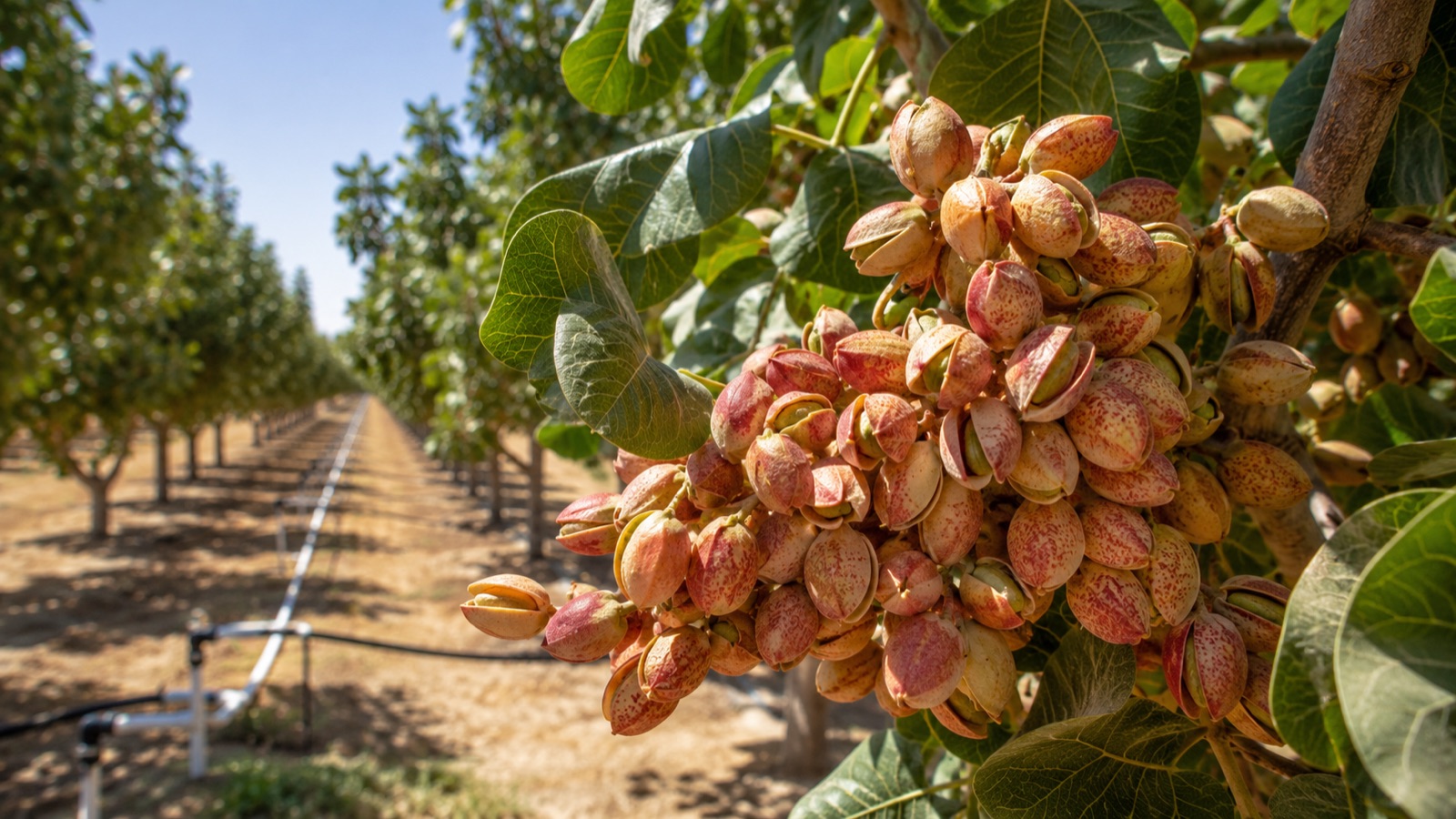
A design intended for professional, mechanisable and digitally managed farming. Final parameters must be validated by a specialist.
Reference parameters
Target productive area
40 ha
Reference spacing
6 × 6 m
Estimated density
278 trees/ha
Theoretical trees
~11,111
Average price per plant
€10.50
Irrigation
Drip irrigation with fertigation
Monitoring
Weather station, sensors and irrigation control
Illustrative image of pistachio in production under localised irrigation.
Variety mix
A mixed planting: two producing cultivars, each with its own pollinator.
Cultivar
Role
Pair
Trees
Share
Kerman
Producing
Peter
7,000
62.9%
Peter
Pollinator
Kerman
784
7.1%
Sirora
Producing
C-Especial
3,000
27.0%
C-Especial
Pollinator
Sirora
336
3.0%
Total allocated
11,120
100 %
Producing trees10,000
Kerman + Peter 8.9:1 · Sirora + C-Especial 8.9:1
Pollinators1,120
10.1%
Producing trees per pollinator8.9:1
Trees ordered11,120
Estimated density: 278 trees/ha
Placement across the estate
Earlier-flowering cultivars go in the colder parts of the estate and later-flowering ones in the warmer parts, following the temperature differences between parcels.
Terracing
On the steeper ground the land is terraced, with level platforms carrying the planting rows. It is the Douro’s traditional answer to farming a hillside, and it settles irrigation, soil and mechanisation in one move.
Water stays where it is applied
On a level platform water infiltrates instead of running downhill. The drip line works at a single elevation, which keeps pressure even and gives every tree the same dose — on a long slope, the same line delivers more at the bottom than at the top.
More soil per tree
Terracing works the soil deeply and banks earth onto the platform. Each tree gets a greater volume of soil to root into than it would on the natural slope, where the useful layer is thin uphill because erosion has carried it down.
Trees on equal footing
Every tree in a row sits at the same elevation, with the same water and the same soil. On an unterraced slope, the lower trees take the runoff from those above and the orchard grows uneven — which is paid for at harvest.
Harvest can be mechanised
A level platform allows machinery through and the use of a trunk shaker, which stops being practical above 20 to 25 % incline. It is what reconciles the available ground with a contracted operating model.
Planting plan
The same 20-metre grid that underpins the land stratification is used to decide what goes into each square. Earlier-flowering cultivars take the cooler ground and later ones the warmer, and any area beyond the orchard is marked as margin.
How cool a cell is does not follow from elevation alone: a north-facing slope receives less radiation and behaves as though it stood higher. The map therefore uses an elevation corrected for aspect and slope, and it is that ordering — warmest cell to coolest — which splits the two cultivar blocks in the proportion of the order placed.
Loading the plan…
Download the plan as GeoJSONOne polygon per cell, carrying block, cultivars, tree counts, elevation, slope and aspect. Opens straight into QGIS or any other GIS.
Production system
The orchard starts under Integrated Production. Conversion to organic stays open, to be decided with the investor in light of how the orchard behaves and what the market pays — and the crop calendar leaves time for that decision to rest on data rather than intent.
Starting under Integrated Production
Integrated Production is the reference system for professional fruit growing: a field record, monitoring of pests and diseases, and intervention only when economic thresholds justify it, favouring biological and cultural methods. It brings the technical discipline of a certified orchard without closing off control options during establishment, the years when a failure is paid for over decades.
Why begin this way
In the early years the orchard is still forming and the real pressure from pests, diseases and weeds on this land is unknown. Starting under Integrated Production allows the planting to be established with room to manoeuvre while building the field record that any later decision will require.
Organic conversion stays open
Moving to organic production is a strategic option, not a commitment made at the outset. It will be assessed with the investor, and depends on parameters only a working orchard reveals: observed disease pressure, approved control methods available for the crop, the price premium paid in the target market, and the support schemes in force.
The calendar works in our favour
Pistachio only comes into production from the sixth year, and organic conversion of a permanent crop requires three years before the first certifiable harvest. That leaves a comfortable window to decide on field evidence: conversion can begin after the orchard is established and still arrive certified in time for the first meaningful harvests.